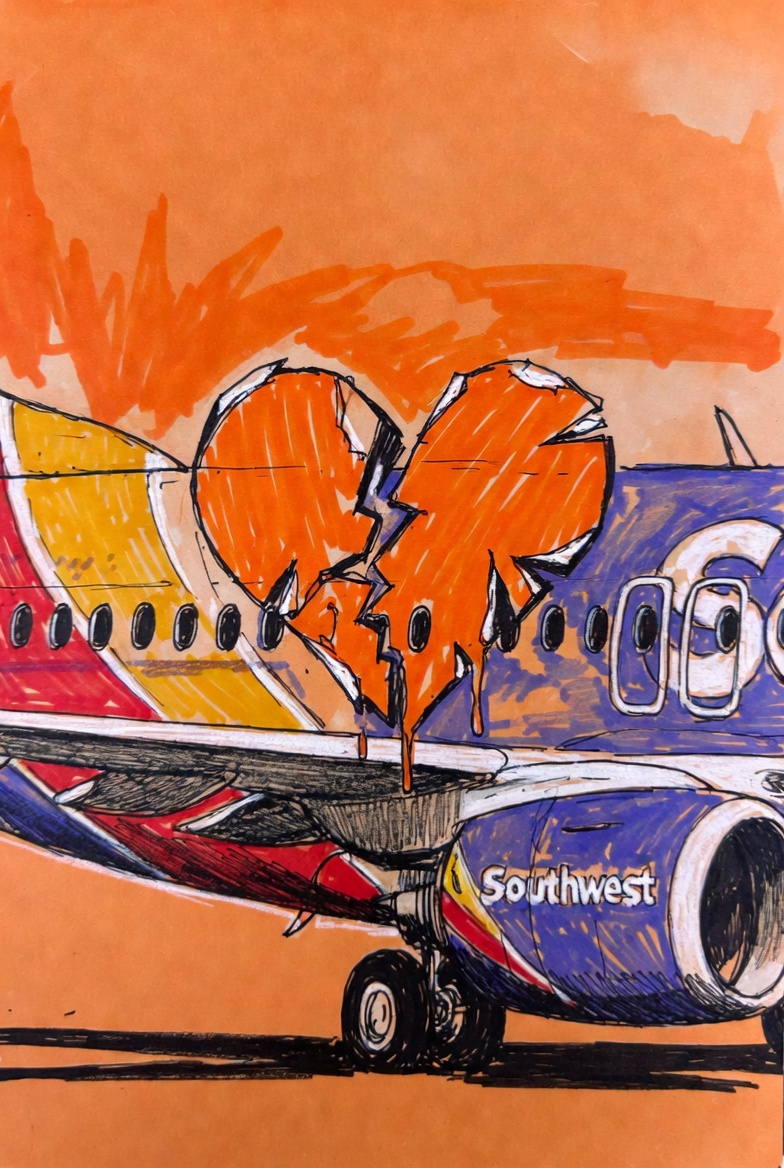
For decades, Southwest Airlines has been the undisputed golden child of American aviation. They were the outliers, the rebels in hot pants who traded the stiff formality of legacy carriers for peanuts, “LUV,” and a seating policy that resembled a middle-school fire drill. They built a brand on a “Why” so powerful it became a corporate religion: The democratization of the skies. But in 2026, the pews are empty. The “Why” has curdled into a set of outdated dogmas that are currently strangling the airline’s operational reality. Southwest is no longer a lean, mean, point-to-point machine; it is a bloated sacred cow grazing on the memories of 1994.
For years, Southwest’s unassigned seating policy was the most protected sacred cow in the paddock. The brand evangelized it. They marketed it as freedom — the last bastion of egalitarianism in a world of tiered boarding and Basic Economy punishments. To the Southwest true believer, a seat assignment was a shackle, a legacy of the stuffy, class-based systems of United or Delta. But in a pragmatic economy, freedom has a price, and for Southwest, that price has become an unbearable Anxiety Tax levied directly on the customer’s psyche.
In the 1970s, when the airline was a scrappy regional player, open seating was a mechanical masterstroke. It was built for turn-times, not for vibe. If you didn’t have to print seat numbers or wait for a passenger in 4B to find their row, you could turn a plane in twenty minutes. It was a “What” that worked. But as the airline scaled into a global titan, the mechanical utility vanished, and the policy was preserved solely as a “Why” — a brand quirk that supposedly made Southwest”different.
The Reality of this freedom in 2026 is that it feels like a second job. Before the recent switch to assigned seating, to fly Southwest was to enter into a mandatory, high-stakes digital lottery. The process begins exactly 24 hours before departure. This is a requirement for survival. If you are thirty seconds late to the check-in button, you are effectively banished to the middle seat in Row 32 next to the lavatory.
For the modern traveler—already exhausted by a frictionless, on-demand world, this isn’t empowering. It’s an exercise in manufactured stress. We live in an era where we can summon a car, a meal, or a movie with a single haptic tap. We outsource our chores to algorithms so we can preserve our cognitive bandwidth. Southwest, conversely, asked us to set a literal alarm clock to perform a manual administrative task just to ensure we don’t have a miserable three hours in the air.
This was the Anxiety Tax. It was the hidden cost of the Southwest “LUV” brand. It was the mental energy required to monitor a boarding position, to strategize the cattle call line, and to perform the awkward “is this seat taken?” dance a hundred times while walking down the aisle. In a high-friction world, the most valuable luxury a brand can provide is the removal of a decision.
Southwest’s defense of open seating was always rooted in a false sense of fairness. They claimed that everyone was equal. But a pragmatic look at the “What” reveals a system that was actually deeply discriminatory.
The open seating model rewarded the the tech-savvy and the solo traveler. It punished families who couldn’t secure three seats together. It punished the business traveler who had a back-to-back meeting and couldn’t hover over their phone at exactly 12:14 PM. It punished anyone with the slightest bit of social anxiety who didn’t want to engage in a low-level turf war for a window seat.
By refusing to offer assigned seats, Southwest was being lazy. They were offloading the logistical burden of seat management onto the customer. They were asking the passenger to be the gate agent, the flight attendant, and the seat-selection algorithm all at once.
The brand insisted that passengers loved the flexibility. But the data told a different story. As the airline’s core customer base aged, and as the Rot Economy made travel increasingly transactional, the novelty of the middle-school fire drill wore off. People didn’t want to be part of a movement. They wanted to know where they were going to sit.
The most damning evidence of Southwest’s blindness was how long it took them to kill the policy. It wasn’t a sudden burst of insight from Elliott’s puppeteering C-suite that led to the 2025 announcement that assigned seating was coming. It was a cold, hard fiscal intervention.
It took a massive drop in revenue and a multi-billion dollar assault from an activist investor (Elliott Investment Management) to finally slaughter the cow. The market had to scream at Southwest for five years before they admitted that their “Why” was actively destroying their “What.”
The airline had spent decades believing their own PR. They thought people flew Southwest because they liked the boarding process. The reality, which any consultant could have told them in five minutes, was that the majority of people flew Southwest despite the boarding process, primarily because of the price and the baggage policy. The open seating was a bug that the brand had re-labeled as character.
When you prioritize a fun brand quirk over the mechanical reality of the market, you are a cult. Southwest was so committed to the theology of “LUV” that they failed to notice that their competitors had simply gotten better at the “What.”
Delta and United figured out how to segment their cabins to offer assigned seats at every price point. They weaponized the very thing Southwest mocked — the seat assignment — to create a hierarchy of comfort that consumers were more than happy to pay for. Southwest, meanwhile, sat in the middle of the barbell, refusing to offer a premium product for the travelers who wanted it and failing to be the cheapest option for the travelers who didn’t.
The death of open seating is the first step in Southwest’s long-overdue Pragmatic Revival. It is an admission that the era of vibes-based aviation is over.
In the new model, Southwest must learn to sell the “What” with the same intensity they once sold the “Why.” They need to stop talking about the spirit of the Southwest employee and start talking about the ergonomics of their new extra-legroom seats. They need to stop marketing “LUV” and start marketing a boarding process that is so boring and efficient that nobody even remembers it happened.
The transition will be painful. The “LUV” religious leaders will complain that the airline has lost its soul. They will mourn the loss of the cattle call as if it were a sacred cultural rite. But for the rest of us — the exhausted, the pragmatic, the people who just want to get to Orlando without a panic attack — the death of this sacred cow is the best news we’ve heard since the invention of the jet engine.
Southwest is finally joining the real world. They are realizing that in 2026, the most loving thing you can do for a customer is to tell them exactly where to sit so they can stop thinking about you.
The “Bags Fly Free” Mirage
If the open-seating policy was the spiritual heart of Southwest, then “Bags Fly Free” is its primary evangelical tool. For two decades, Southwest has dumped hundreds of millions of dollars into a marketing machine designed to convince you that they are the only honest brokers in a sky full of thieves. They’ve built an entire transparent brand identity around the absence of a line item. They want you to believe that while Delta and American are reaching into your pockets like common pickpockets, Southwest is the benevolent benefactor, absorbing the cost of your overpacked suitcase out of the goodness of their corporate heart.
It is a beautiful “Why.” It’s the story of a brand that stands with the little guy against the fee-hungry legacy carriers. But from a pragmatic perspective, the “Bags Fly Free” campaign is a sophisticated accounting mirage.
There is no such thing as a free lunch, and in the high-stakes physics of commercial aviation, there is certainly no such thing as a free 50-pound suitcase.
To understand the mirage, you have to look at the “What” of an airplane. An aircraft is a closed system of weight, fuel, and lift. Every additional pound of luggage requires a mathematically specific amount of jet fuel to move it from Point A to Point B. This is a physical cost that must be paid.
When a brand tells you that a service with an inherent physical cost is “free,” they are lying to you about the math. They aren’t waiving the cost; they are merely masking it.
In the case of Southwest, the cost of handling, fueling, and transporting millions of suitcases is not absorbed by the company’s profit margins. Instead, that cost is surgically baked directly into the base fare of every single ticket. Southwest isn’t saving you money; they are simply stripping away your ability to choose not to pay for a service you might not be using.
This is where the transparency brand identity begins to crumble. True transparency is unbundling. It is the “What” of modern retail: I pay for exactly what I consume. If I want a seat, I pay for a seat. If I want a bag, I pay for a bag. If I want a gin and tonic, I pay for a gin and tonic.
By refusing to unbundle, Southwest has created an inefficient, quasi-socialist pricing model. They are effectively running a cross-subsidy program where the light-traveling business professional — carrying nothing but a slim laptop bag — is forced to pay for the three massive checked trunks of the family in Row 12. The minimalist is subsidizing the hoarder. In a capitalist sky, this is a systemic misallocation of cost.
Beyond the internal unfairness of the cross-subsidy, “Bags Fly Free” has become a strategic anchor dragging down Southwest’s competitiveness in the digital age.
We live in a “What” economy where the primary interface for travel is the search engine — Google Flights, Kayak, Expedia. These platforms are the ultimate auditors. They don’t care about your “LUV” philosophy or your quirky commercials. They care about a single, verifiable metric: the base price.
When a consumer searches for a flight from Dallas to Chicago, the algorithm presents a list of options ranked by the “What” — the price of the seat. Spirit, Frontier, and even the Basic Economy tiers of the legacy carriers appear at the top of the list because they have unbundled the experience. They show you the price of the transportation alone.
Southwest, tethered to its sacred cow of “free” bags, often appears further down the list. Their base price looks expensive because it includes the hidden tax of two checked bags. Even if a traveler has no intention of checking a bag, Southwest forces them to buy the Bag Inclusive version of the flight.
In the 1990s, when people booked flights over the phone or through travel agents, you could explain away this price difference with a clever marketing pitch. But in 2026, the algorithm has no ears. It doesn’t listen to the “Why.” It only indexes the “What.” By refusing to let the bag fee stand on its own, Southwest has effectively opted out of the top-of-funnel competition for the modern, price-sensitive traveler. They are losing the battle of the “What” before the consumer even clicks on their website.
The mirage extends into the operational reality of the airline itself. Because the bags are “free,” there is no natural friction to prevent passengers from overpacking. This leads to a “What” problem that Southwest fans rarely acknowledge: slower turn-times and more weight-and-balance issues.
When baggage is a paid add-on, consumers become pragmatic. They edit. They pack lighter. They carry on. This speeds up the boarding process and reduces the strain on the ground crew. By making bags “free,” Southwest encourages every passenger to bring the maximum allowed weight. This increases the total weight of the aircraft, which increases fuel burn, which — ironically — forces Southwest to raise the base fare even higher to cover the costs.
It is a feedback loop of inefficiency. The more they market “Free Bags,” the more bags they have to carry, the more fuel they burn, and the more expensive their base fares become on the search engines.
This is the ultimate failure of purpose-driven marketing. Southwest is so committed to the idea of being the no-fee airline that they are willing to ignore the mechanical reality that their pricing model is making them less competitive every single year. They have prioritized the brand story over the operational math.
The End of the Gimmick
For a long time, Southwest could survive this inefficiency because they were the low-cost leader in other areas; primarily their fuel hedging and their 737 monoculture. But those advantages have evaporated. Everyone else caught up on the “What.”
In 2025, Southwest’s reputation for value took a massive hit as inflation forced them to hike fares. When the “What” (the price) stops being the lowest in the market, the “Why” (the free bags) starts to look like a gimmick. Travelers are smart. They are starting to do the math. They are realizing that they can fly a legacy carrier for $100 less and just pay the $35 bag fee if they actually need it. They are realizing that the “free” bag is actually the most expensive bag in the sky.
The “Bags Fly Free” campaign is the terminal stage of a brand that has lost its way. It is a marketing department trying to solve an engineering problem. It is an attempt to use “LUV” to distract from the fact that the airline’s cost structure is no longer lean.
To survive, Southwest needs to stop being transparent and start being honest.
Honesty means admitting that it costs money to move a suitcase. Honesty means unbundling the fare so that the minimalist doesn’t have to pay for the maximalist. Honesty means competing on the “What” of the actual seat price and letting the customer decide which additional utilities they want to purchase.
The mirage is fading. The consumer of 2026 isn’t looking for a brand that treats them like a family member; they are looking for a brand that treats them like a rational economic actor. They don’t want “LUV.” They want a fair price for a specific service.
In the early 1970s, Southwest’s decision to fly only the Boeing 737 was a stroke of mechanical genius. It was the ultimate “What” — a decision rooted in the hard logic of operational efficiency. By maintaining a single fleet type, Southwest eliminated the logistical complexity that plagued legacy carriers. They didn’t need to train pilots on multiple cockpits. They didn’t need to stock a diverse inventory of spare parts in every outstation. Every mechanic, every flight attendant, and every dispatcher knew the 737 like the back of their hand. This “What” allowed them to achieve the fastest turn-times in the industry and offered a cost structure that was the envy of the aviation world.
But in 2026, this legendary efficiency has transformed into a systemic single point of failure. Southwest has traded operational resilience for a purity that no longer serves the scale of a global airline. They are a brand that has put all its eggs in one basket, and the basket is currently disintegrating.
The Biological Risk of a Technical Monoculture
In biology, a monoculture is a population with zero genetic diversity. It is incredibly efficient for a time, but it is also uniquely vulnerable. One specific virus, one targeted parasite, can wipe out the entire species because there are no outliers with natural resistance.
Southwest has created a technical monoculture. Because their entire business model is tethered to the Boeing 737, they have no genetic diversity to protect them when the manufacturer stutters. When Boeing suffers a systemic failure, Southwest experiences a total mechanical seizure.
The Boeing MAX groundings and subsequent delivery delays were the first major symptoms of this disease. While Delta and United could pivot to their Airbus fleets or rely on their Embraer regional jets to bridge the gap, Southwest was left paralyzed. They were forced to cancel thousands of flights and park a significant portion of their capacity because their “What” had been taken offline by a third party. They had no backup plan because their “Why” — the religious devotion to fleet uniformity — prevented them from even considering a diversified fleet.
This is a fundamental strategic failure. In a volatile global economy, the most valuable asset a brand can possess is resilience. Resilience is the ability to absorb a shock and keep moving. By refusing to diversify, Southwest opted for a brittle efficiency. They chose to be the fastest runner in the race, but they forgot to bring a spare pair of shoes. Now that the shoes have holes in them, they are forced to limp along while the competition sprints past.
The monoculture problem is currently being compounded by an aging fleet that Southwest cannot seem to replace fast enough. A significant portion of the Southwest workhorse remains the 737-700. These are the legacy jets — the planes that built the brand in the late 90s and early 2000s. They are reliable, but they are old. They are less fuel-efficient, more expensive to maintain, and they lack the modern cabin features that travelers in 2026 have come to expect as a baseline utility.
Southwest’s plan was to replace these aging airframes with the newer, more efficient MAX 7. However, the MAX 7 has been stuck in a perpetual state of certification hell. Because Southwest is so deeply invested in the purity of the 737 family, they have sat and waited for Boeing to fix its internal house while their own fleet continues to age.
This is the “What” in its most neglected form. Every day a 20-year-old 737-700 stays in the air, Southwest’s operational costs creep higher. Every day they wait for a delivery that may or may not happen, their capacity is capped. A pragmatic brand would have looked at the Boeing timeline three years ago and walked across the street to Airbus. They would have placed an order for the A220 or the A320neo to protect their future.
But Southwest couldn’t do that. To buy an Airbus would be to admit that the Southwest Way was no longer the only way. It would require them to break the sacred cow of fleet uniformity. They chose to protect the brand’s ego rather than its engineering.
The refusal to diversify is a purity tax that Southwest is passing directly to its shareholders and customers.
The monoculture was originally intended to save money, but it is now the single largest driver of operational risk. We saw this risk manifest in its most brutal form during the 2022 holiday meltdown. While the primary culprit was a legacy crew-scheduling software system, the inability to move crews between different types of aircraft or leverage a more flexible fleet contributed to the systemic gridlock.
In a diversified fleet, a pilot qualified on an Airbus A321 can’t fly a Boeing 737, which sounds like an inefficiency. But in a crisis, a diversified fleet allows a company to isolate problems. If the 737 fleet is grounded for a mechanical issue, the Airbus fleet keeps flying. For Southwest, there is no isolation. There is only the contagion.
The brand’s identity is so wrapped up in being a Boeing shop that they have become a hostage to Renton. They are a subsidiary of the Boeing corporate crisis.
The “Culture of Fun” as a Shield for Incompetence
If “Bags Fly Free” is the evangelical tool and the 737 is the mechanical heart, then the “Culture of Fun” is the aesthetic armor of Southwest Airlines. For half a century, Southwest has used a specific brand of corporate whimsy to differentiate itself from the suits at the legacy carriers. We have all experienced it: the flight attendant who delivers the safety briefing in a rap, the gate agent who initiates a contest for the passenger with the largest hole in their sock, and the relentless, pervasive use of “LUV” as a corporate suffix.
This performance was originally designed to humanize the brand, to signal that Southwest was an un-airline that didn’t take itself too seriously. It was a “Why” that felt revolutionary in a world of stale coffee and starchy uniforms. In 2026, am begging us to ask a harder question: What is this performance actually covering up?
In 2026, it is increasingly clear that Southwest’s “Culture of Fun” has transitioned from a brand asset into a psychological shield — a way to mask a decades-long atrophy of the airline’s underlying operational infrastructure. When the “Why” is this loud, it’s usually because the “What” is screaming for help.
There is a specific kind of cognitive dissonance that occurs when a brand uses humor to bridge a utility gap. In the marketing world, this is often a diversionary tactic. If you can make the customer laugh, they are less likely to notice that the seat doesn’t recline or that the plane is thirty years old.
At Southwest, this whimsy has been industrialized. It is part of the training manual. But there is a fine line between authentic hospitality and performative distraction. When a flight attendant cracks a joke while you’ve been sitting on the tarmac for forty minutes without an update, the joke is an insult. It is a refusal to acknowledge the reality of the customer’s situation.
The “Culture of Fun” acts as a form of emotional gaslighting. It suggests that if you are frustrated by the operational friction of the airline, you are simply not getting the vibe. You are a party pooper in a corporate-sanctioned celebration. This creates a culture where legitimate criticism is dismissed as a lack of “LUV,” and where the staff is encouraged to use personality as a substitute for precision.
In a pragmatic economy, consumers don’t want a fun flight. They want a predictable flight. They want the “What” of on-time arrival, functioning WiFi, and a boarding process that doesn’t feel like a carnival act. When a brand prioritizes the performance over the plumbing, it creates a systemic vulnerability. You can only joke your way out of a delay for so long before the customer starts looking at the clock.
The ultimate proof of this theory arrived during the Christmas of 2022. It was the moment the “Why” finally failed, and the “What” was exposed in all its rusted, neglected glory.
While a massive winter storm hit the entire United States, most airlines recovered within 48 hours. Southwest, however, suffered a total systemic seizure that lasted for nearly two weeks. They cancelled over 16,000 flights, stranded millions of passengers, and lost nearly $800 million in a matter of days.
The autopsy of the meltdown revealed a horrifying truth: Southwest’s internal crew-scheduling software — the SkySolver system — was essentially a digital relic from the 1990s. It was a “What” that had been ignored for decades while the company spent billions on “LUV” commercials and share buybacks. When the storm hit, the software couldn’t keep track of where the pilots and flight attendants were. The airline literally lost its employees.
The “Culture of Fun” was powerless in the face of this mechanical failure. You cannot rap your way out of a total infrastructure collapse. The singing flight attendants were just as stranded as the passengers, and the “LUV” branding looked like a cruel joke to the thousands of people sleeping on terminal floors next to piles of unclaimed luggage.
The meltdown was the definitive takedown of the Southwest model. it proved that a brand that invests in its “Why” (the culture) at the expense of its “What” (the technology) is a brand built on sand. For decades, Southwest had used its legendary employee culture to brute force their way through operational hiccups. They relied on the heroic efforts of individual staff members to overcome the failings of their outdated systems. But heroism doesn’t scale. Eventually, the systems become so broken that no amount of “LUV” can bridge the gap.
The “Culture of Fun” is simultaneously a management tool for employees. Southwest has long touted its labor relations as a loin from their Sacred Cow. They claim that because they put their employees first, the employees will, in turn, put the customers first.
But look closer at the “What” of Southwest’s labor relations in 2025 and 2026. The airline has faced increasingly bitter contract negotiations with its pilots and flight attendants. The “LUV” is fraying. Why? Because the employees are exhausted by the “What.” They are the ones who have to deal with the broken scheduling software. They are the ones who have to apologize for the aging 737-700s. They are the ones who have to perform the fun identity while their actual working conditions are deteriorating.
Management has used the “Culture of Fun” as a way to avoid making the hard, expensive investments in operational resilience. It’s much cheaper to hold a Spirit Day than it is to replace a mainframe. It’s easier to talk about The Southwest Way than it is to diversify a fleet. The “Why” has become a tool of executive laziness — a way to maintain the status quo while the competitive landscape shifts beneath them.
This is a danger of a mission-driven brand. When the mission (the “Why”) becomes more important than the product (the “What”), the leaders start to believe their own mythology. They stop looking at the metrics and start looking at the manifesto. They assume that as long as everyone is smiling, the business is healthy.
The Solution: Killing the Performance
To fix Southwest, you have to start by silencing the rap.
The Pragmatic Revival of Southwest Airlines requires a total abandonment of the performative brand. They need to enter a period of strategic silence.
- The Infrastructure Audit: Take the $200 million annual marketing budget and dump it entirely into a five-year cloud-native overhaul of every piece of internal software. The “What” of the airline must be the most advanced in the industry, not the most charismatic.
- The Professionalization of Service: End the “Fun” briefings. Return to a standard of quiet, professional, and efficient service. Signal to the customer that you are taking their time and their safety seriously, rather than treating the flight like a low-budget variety show.
- The Utility Pivot: Rebrand Southwest as the logistics leader. Stop talking about the heart and start talking about the hub. Move the point-to-point model toward a more resilient “lily-pad” structure that can absorb weather shocks without collapsing.
- The Accountability “What”: Instead of offering “LUV” vouchers when things go wrong, offer hard, cold cash based on specific delay metrics. Make the penalty for failure so high that the organization is forced to prioritize operational excellence over brand storytelling.
Southwest needs to realize that in 2026, the most radical thing an airline can do is be boring. We don’t want to be entertained at 35,000 feet. We want to be transported. We want a brand that understands that its “Why” is secondary to its ability to take off and land on time.
The LUV hangover is over. The “Why” has been thoroughly debunked by the reality of the terminal floor. It is time for Southwest to stop the performance, pick up the wrench, and finally fix the “What.”
 Pragmatic Revival
Leave a comment