
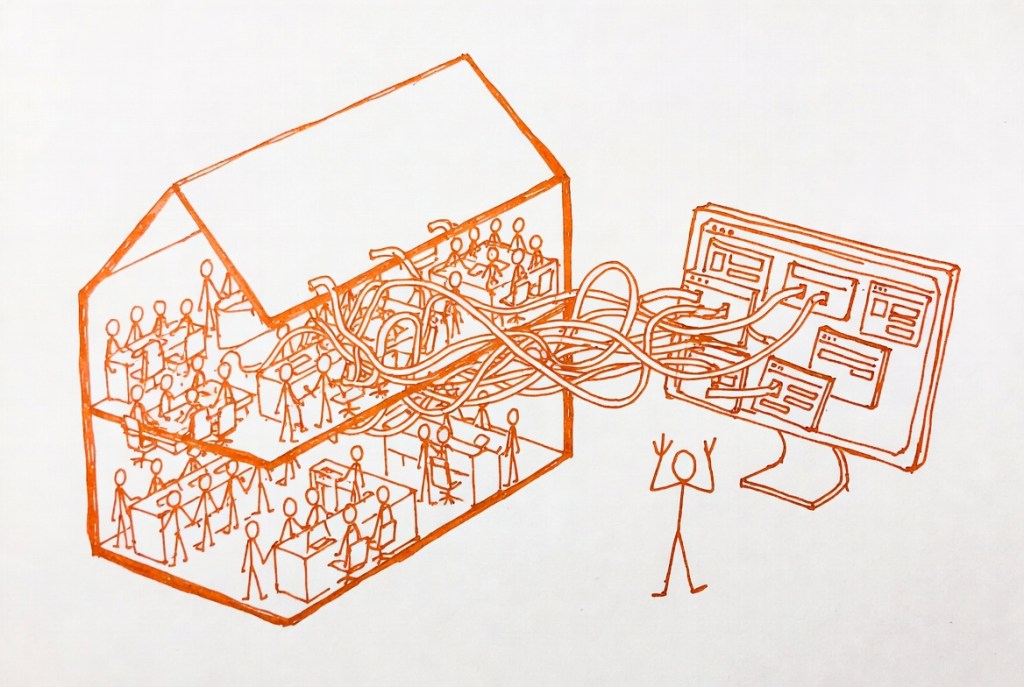
When computer programmer Melvin Conway submitted a paper to the Harvard Business Review in 1968, the editors rejected it. He took his observations to Datamation magazine instead, where his central thesis quietly became a foundational rule of software engineering. Conway observed a simple, inescapable truth: any organization that designs a system will inevitably produce a design whose structure mirrors the organization’s own communication network. Assign four isolated software teams to build a compiler, and you will invariably get a four-pass compiler. The architecture of the final product simply reflects the boundaries of the people who built it.
This principle extends far beyond code. Conway identified a universal law of organizational behavior—the internal habits of an institution dictate the shape of its external output. Today, there is no more flawless, sprawling laboratory for this observation than the modern university campus.
Higher education operates as a highly complex ecosystem defined by entrenched academic manors and strict departmental autonomy. Often, the physical geography of the campus perfectly maps the bureaucratic divide. University Communications occupies a suite in a legacy administrative building, prioritizing high-level brand awareness and the alumni magazine. The Vice President for Enrollment Management commands a newly renovated welcome center, obsessing over yield models and the daily dashboard of deposited students. Across the quad, academic deans rule their individual colleges, frequently operating under a Responsibility Center Management (RCM) budget model that treats each college as a distinct profit center—incentivizing deans to hoard tuition revenue and protect their applicant data from central administration.
These units report through entirely different bloodlines. Deans answer to the provost. The admissions director reports to the enrollment VP. The marketing director reports to the president. They rarely interact on a daily operational level. Yet, when these isolated entities attempt to recruit a single prospective student, the resulting brand experience reflects their internal divisions with absolute, punishing precision.
The Fragmented Student Journey
To understand the severity of this diagnosis, you only need to trace the digital footprint of a high school senior who fills out a standard Request for Information form.
The student checks a box indicating an interest in healthcare administration. Initially, the record lands safely in central admissions’ primary instance of Slate, triggering a standardized communication flow. For the next few weeks, the student receives a choreographed sequence of emails highlighting a vibrant campus community, complete with officially approved color palettes, homecoming football reminders, and cheerful testimonials. The aesthetic is warm and inviting.
But behind the scenes, a background routing rule has already compromised the experience. Because the student flagged an interest in healthcare, the system copies the record and forwards it to an enrollment coordinator housed within the college of business.
Operating as a highly protective financial silo, the business dean views every prospective student as a critical unit of tuition revenue necessary to meet budget projections. Bypassing central marketing entirely, the college uploads the student’s data into a shadow email platform and deploys creative assets produced by a boutique freelance agency hired directly by the dean. Suddenly, the student’s inbox is hit with a jarring aesthetic shift. The business school’s emails feature aggressively corporate language, heavily emphasizing networking and ROI, wrapped in a harsh, high-contrast color palette. The tone pivots instantly from a welcoming residential community to a hyper-competitive professional environment.
The fragmentation deepens when the student officially applies. Their high GPA triggers an automated alert within the honors college—a unit operating out of a restored historic house on the edge of the quad, funded by a private endowment. An administrative assistant pulls a daily report and generates a physical mailing. Days later, a thick envelope arrives at the student’s home, proudly stamped with an intricate academic crest that the board of trustees formally retired three years ago.
Picture the high school senior sitting at a kitchen table, looking back and forth between a phone screen and a physical letter. They are perceiving three distinct, uncoordinated organizations fighting for attention. The invisible boundaries of the university’s organizational chart are manifesting directly inside their inbox.
Human beings subconsciously process this kind of disorganization as a severe warning signal. When the digital ecosystem is chaotic, the prospective student naturally assumes the underlying academic experience will suffer from the exact same friction. If a university sends contradictory emails, the student assumes it will be equally difficult to schedule an academic advisor, process a transcript, or disburse a federal loan.
The financial tragedy here occurs at the very top of the funnel. The executive cabinet likely approved a massive media buy to generate the initial awareness, plastering billboards along interstates and blanketing Instagram with targeted ads. The institution spent millions building brand equity, only to systematically dismantle it through disjointed operational execution downstream.
The RCM Trap & Rogue Marketing
None of this originates from malice or incompetence. The root cause is almost entirely financial.
The most formidable structural blocker to a unified university identity is the Responsibility Center Management budget model. Under this framework, central administration treats academic units as standalone businesses. A college retains the tuition revenue generated by its enrolled students and pays a predetermined operational tax back to the center for shared services.
When you tell a nursing dean that their ability to hire faculty or purchase medical simulation equipment hinges strictly on their localized enrollment yield, a profound behavioral shift occurs. The financial risk is simply too great to leave in the hands of an external admissions office. Consequently, individual colleges begin hoarding critical prospect data. Deans quietly reallocate departmental funds to hire shadow marketing coordinators, launching decentralized sub-brands to ensure their survival in a competitive internal ecosystem.
This decentralized model successfully incentivizes severe institutional self-harm. Academic deans begin viewing central administration as a tax collector and their peer colleges as direct competitors. This internal rivalry spills directly into the external marketplace. It is entirely common to find a college of business and a college of communications competing for the exact same pool of undergraduates, with shadow coordinators bidding on the exact same search terms on Google. The university actively bids against itself, artificially driving up the cost-per-click and draining funds that could have been deployed for student success initiatives.
The architecture of the budget inherently prevents the architecture of a cohesive brand.
Prescribing Structural Integration
When application numbers dip and summer melt spikes, leadership typically misdiagnoses the symptom. The cabinet initiates a massive brand architecture project, hiring an external agency to develop a unified messaging platform and a fresh ad campaign.
But a messaging platform cannot fix a structural reality. Public relations strategies hold zero power to mask the friction of a broken internal system. Fixing a Conway problem demands rigorous structural execution. To present a unified face to the market, the university must force communication through a centralized operational infrastructure.
This begins deep within the technological plumbing. Data centralization is paramount. A project team must systematically locate and dismantle every shadow database, prying isolated CRM platforms out of the colleges’ hands to construct a single, unified data environment capable of tracking a student from their first web inquiry as a sophomore to their philanthropic giving as an established alumnus. To accomplish this, central administration has to broker a trade with highly protective deans: strict adherence to master brand guidelines in exchange for guaranteed, highly targeted lead generation. The dean of engineering will only use the central system if the central system actually fills the engineering lecture halls.
The final phase requires immense political endurance from the executive cabinet. A sprawling university cannot sustain a unified identity if every center, institute, and department clings to a bespoke logo designed decades ago by a well-meaning graduate student. Leadership must authorize a comprehensive audit of the visual landscape, systematically eliminating the chaotic architecture of localized sub-brands. The academic colleges must transition away from operating as independent corporate entities and take their proper place as specialized chapters within a larger institutional narrative. The unique engineering crest and the distinct business school wordmark must disappear, replaced entirely by the unified typography and color palette of the master university identity.
This will generate intense pushback. Tenured faculty will view the loss of a departmental logo as an erosion of academic independence. Legacy alumni will threaten to withhold donations when their specific college loses its distinct crest. The president has to hold the line, refusing to grant exceptions to powerful deans or vocal donors.
A unified outward presence is the direct byproduct of unified inward operations. If the administration builds a seamless, cooperative internal environment, the student feels welcomed by a competent organization. Until the university deliberately designs a structure that forces internal collaboration, the external market will continuously spot the cracks in the org chart. Execution is the only fix.


Leave a Reply